

Malaysia · Research
Real Estate Highlights 1H 2026
A comprehensive analysis of Malaysia's industrial, data centre, office, retail, hospitality and residential markets.
Download the report
PDF · 21 MB

Scroll Down to know more
A resilient economy navigating global headwinds
Malaysia recorded GDP growth of 5.4% y-o-y in 1Q2026, supported by household spending, a resilient labour market and sustained private investment, even as geopolitical tensions and trade uncertainty weighed on the external environment.
Domestic demand carries 5.4% growth
Household spending, a resilient labour market and steady private investment powered the quarter, while 1.6% inflation and a 2.75% OPR kept conditions benign.
+ continue reading
Malaysia's economy expanded by 5.4% year-on-year (y-o-y) in 1Q2026, supported by continued household spending, resilient labour market and steady private investment. Investment remained supported by continued expansion in technology, digital infrastructure and data centres, while export growth continued to be driven by electrical and electronics (E&E) products, as well as travel and ICT services. Bank Negara Malaysia maintained the Overnight Policy Rate (OPR) at 2.75%, providing a stable monetary environment despite an increasingly uncertain external landscape.
Escalating geopolitical tensions arising from the US-Israel war on Iran heightened concerns over global energy supply disruptions, resulting in higher crude oil prices and renewed inflationary pressures. The conflict also affected regional aviation, with the suspension of several Middle Eastern flight routes reducing aircraft movements and adding uncertainty to the tourism and hospitality sectors. Global crude oil prices retreated to near pre-war levels in June 2026 amid a fragile truce between the US and Iran, and renewed diplomatic efforts to de-escalate the conflict. While tensions have eased, uncertainty surrounding the ceasefire and the evolving geopolitical landscape continues to pose downside risks to global trade, business confidence and investment activity.
Domestically, the Government continued its subsidy rationalisation agenda by reducing the BUDI95 monthly fuel quota to 200 litres in March 2026. Further strengthening these efforts, the Government announced the Budi Madani Diesel (Budi Diesel) programme, to be implemented from July 2026, replacing monthly cash assistance with a MyKad-based fuel subsidy mechanism providing eligible recipients with up to 200 litres of subsidised fuel per month. The initiative is expected to improve subsidy targeting while supporting the Government's broader fiscal consolidation efforts.
| HEADLINE INFLATION · 1Q2026 | 1.6% | +0.1 ppt vs 1Q2025 | 4Q2025: 1.3% | 1Q2025: 1.5% | 2026(f): 1.3%–2.0% |
| UNEMPLOYMENT RATE · 1Q2025 | 2.9% | -0.2 ppt vs 1Q2025 | 4Q2025: 3.0% | 1Q2025: 3.1% | 2026(f): 3.0% |
| OVERNIGHT POLICY RATE (OPR) | 2.75% | — | Maintained by Bank Negara Malaysia; stable monetary environment |
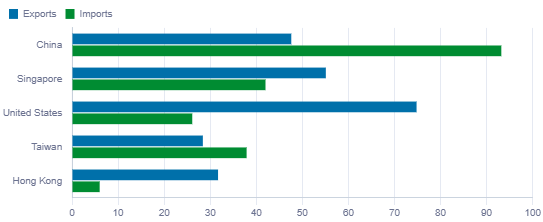
Exports up 12.7% on E&E strength
Total trade reached RM 789.8 bil in 1Q2026; E&E products, travel and ICT services led the export push even as the ringgit stayed volatile against the US dollar.
+ continue reading
Although the Malaysian ringgit appreciated against the currencies of most major trading partners in 1Q2026, it experienced heightened volatility against the US dollar amid evolving expectations over US interest rates, global trade uncertainty and geopolitical risks. Nevertheless, the ringgit's movement broadly mirrored trends across other regional Asian currencies and remained largely driven by external developments rather than weakening domestic fundamentals. Looking ahead, resilient domestic demand, sustained investment activity and continued demand for technology-related exports are expected to support Malaysia's economic growth, although local political developments, geopolitical tensions and global trade uncertainties are likely to continue weighing on business and investment sentiment.
| TOTAL EXTERNAL TRADE · 1Q2026 | RM 789.8 bil | — | Exports RM 426.5 bil + Imports RM 363.3 bil |
| EXPORTS · 1Q2026 | RM 426.5 bil | +12.7% y-o-y | 4Q2025: RM 436.0 bil (+11.0% y-o-y) | 1Q2025: RM 384.2 bil |
| IMPORTS · 1Q2026 | RM 363.3 bil | +7.7% y-o-y | 4Q2025: RM 387.5 bil (+11.7% y-o-y) | 1Q2025: RM 337.3 bil |
Domestic investors step up as FDI cools
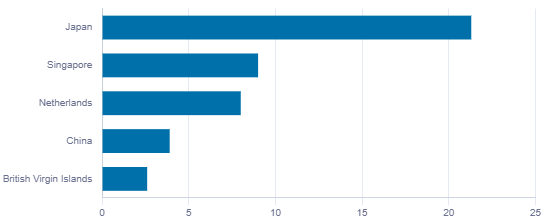
Approved domestic investment rose 13.0% to RM 36.7 bil while foreign commitments eased 7.3% — technology, digital infrastructure and data centres still anchor the pipeline.
| DOMESTIC INVESTMENT (DDI) · 1Q2026 | RM 36.7 bil | +13.0% y-o-y | 1Q2025: RM 32.4 bil | 2025(r): RM 222.4 bil |
| FOREIGN INVESTMENT (FDI) · 1Q2026 | RM 56.2 bil | -7.3% y-o-y | 1Q2025: RM 60.6 bil | 2025(r): RM 208.7 bil |
Every sector signal points up
Industrial output, services prices, retail sales, tourist arrivals and house prices all advanced — a supportive backdrop for the six property chapters that follow.
| INDUSTRIAL PRODUCTION INDEX (IPI) · 1Q2026 | 138.7 pts | +4.0% y-o-y | 1Q2025: 133.3 pts. Stronger industrial output supports continued demand for industrial and logistics space. |
| PURCHASING MANAGERS' INDEX (PMI) · JAN–JUN 2026 | 50.7 pts | +2.8% y-o-y | PMI readings in expansionary territory in 4 months out of the last 6. Improving manufacturing sentiment supports a favourable outlook for industrial and logistics sector. |
| SERVICES PRODUCER PRICE INDEX (SPPI) · 1Q2026 | 119.0 pts | +1.4% q-o-q | +1.4% q-o-q / +2.1% y-o-y. Growth broad-based; real estate activities +0.4% and professional services +0.8% q-o-q. |
| MALAYSIA RETAIL SALES GROWTH · 1Q2026 | 3.7% | +3.7% y-o-y | +3.7% y-o-y. Driven by festive spending and government cash assistance programmes; VM2026 expected to sustain growth. |
| MALAYSIA TOURIST ARRIVALS · 1Q2026 | 6.5 mil | +2.5% y-o-y | +2.5% y-o-y. International arrivals at 97% of pre-pandemic levels; VM2026 targeting 47 million arrivals and RM 147.1 bil in tourism receipts. |
| MALAYSIA HOUSE PRICE INDEX (MHPI) · 1Q2026 | 235.3 | +1.7% y-o-y | +1.7% y-o-y. Supported by a 1.3% rise in the high-rise residential sub-index, reflecting resilient property values despite softer market conditions. |